Hypothesis Thinking Toolkit

.svg)
.svg)

Hypothesis-led thinking is an approach that will help you get into the rhythm of conducting experiments in your daily work. You may have already heard of 'Validated Learning' as Lean Startup calls it, which is all about getting the most effective efficient results with the leanest approach and use of resources.
It is about formulating assumptions explicitly as hypotheses, so that they can be tested through experimentation and data collection. This method involves formulating clear, testable hypotheses about how different aspects of a product, service, or business model will perform in the real world, and then designing experiments to validate or invalidate these hypotheses.

Why is this important for innovation
This approach is crucial for innovation because it reduces risk by identifying and addressing potential flaws early, before significant investments are made. It informs decision-making with data-driven insights, reducing reliance on intuition or guesswork. By emphasising a culture of continuous learning and improvement, it views failures as valuable sources of information rather than setbacks, enhancing the agility of teams to pivot or adjust strategies quickly based on empirical evidence. Moreover, it focuses on validating assumptions about customer needs and behaviours, ensuring that innovations are aligned with real market demands. Hypothesis-led Thinking fosters a systematic, evidence-based approach to innovation, making it a key driver of successful, sustainable development in any industry.
What to expect from this toolkit
🏋️ Methods
- Arche Assumption Canvas: This Canvas helps you to formulate your assumptions combining the three perspectives of desirability, feasibility, and viability.
- Assumption Mapping: The Assumption Mapping Cheatsheet helps to prioritise assumptions about an idea or product. It aims to identify the critical assumptions that need to be validated to justify the value of an idea or product and further investment in resources for it.
📖 To Read
- The Sweet Spot for Innovation: Learn about the trifecta of desirability, feasibility and viability for the ideal innovation process.
- Testing Business Ideas: Learn how to increase the success of any venture by providing a practical guide to rapid experimentation.
- The Innovator's Hypothesis: Learn about the concept of innovation and a new approach to it.
- Experimentation Works: Let this book guide you through best practices in business experimentation, how these practices work at leading companies, and some fundamental questions: What makes a good experiment? How do you test in online and brick-and-mortar businesses? In B2B and B2C? How do you build an experimentation culture?
- The Power of Experiments: Learn about the benefits of using experiments to make better business decisions.
Download (find below)👇
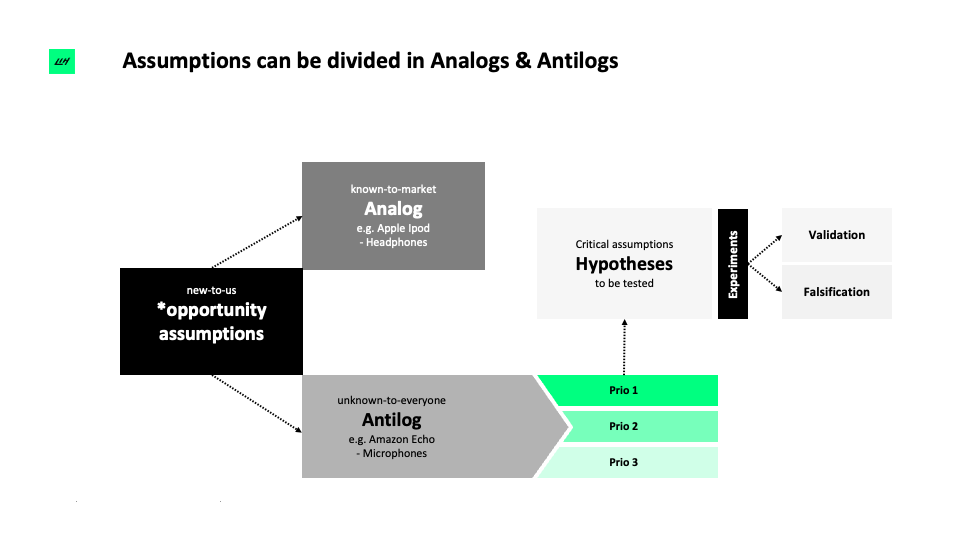
- Analogs & Antilogs: How assumptions can be divided in analogs (known) and antilogs (unknown).
- Experiment Planner: You will find all the different types of experiments you can use to either discover a potential idea or validate an existing one. This pack will walk you through how to establish an hypothesis, as well as how to select and plan an experiment.
.svg)
.svg)